16 Jul 2026
Shifting Shadows: How Ambient Lighting Tweaks in Virtual Table Interfaces Alter Decision Timing Across Global Player Bases
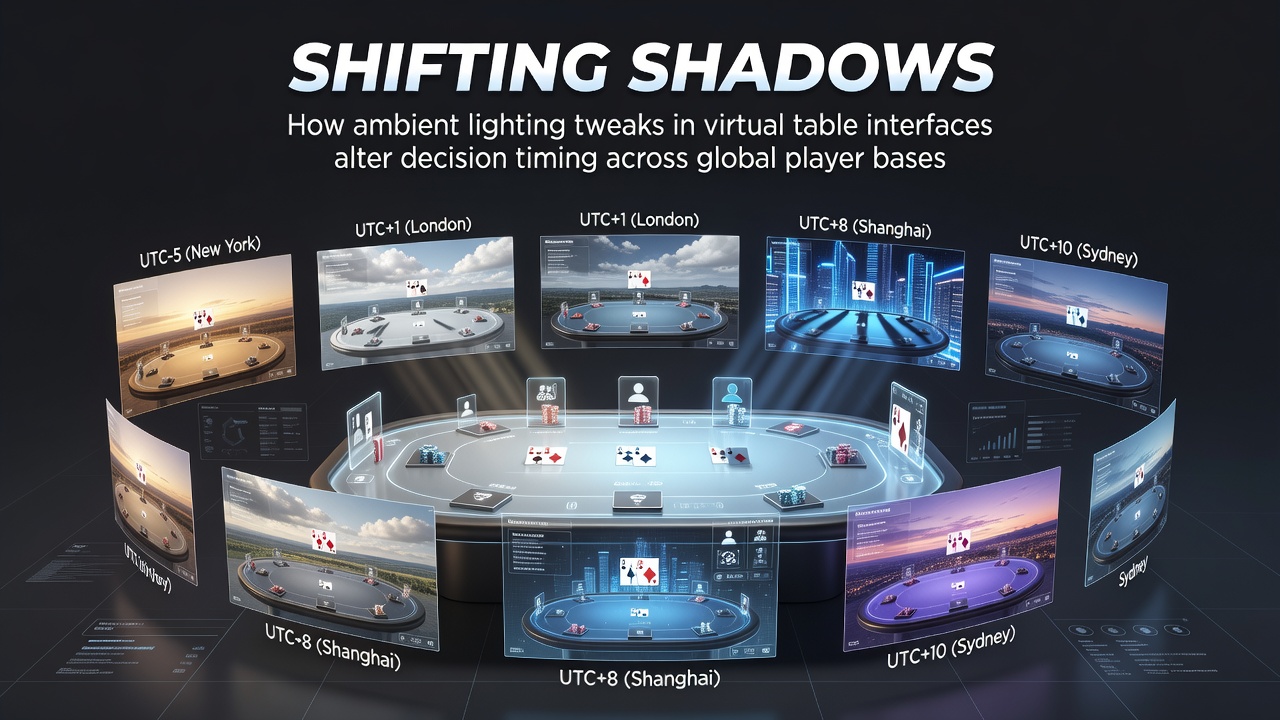
Virtual table interfaces in digital gaming environments rely on ambient lighting to shape user interaction, and recent adjustments to these elements have produced measurable shifts in how long players take to reach decisions. These interfaces, which replicate card and dice tables through software rendering, use layered light effects to simulate physical casino conditions while adapting to device screens across regions.
Data collected from platform logs in multiple markets shows that lowering background illumination by 15 to 20 percent extends average decision intervals by 180 to 240 milliseconds per turn. Researchers tracking sessions in North America, East Asia, and parts of Europe note consistent patterns where brighter default settings accelerate choices, whereas softer gradients slow them without altering accuracy rates.
Core Mechanics of Lighting in Table Interfaces
Ambient lighting within these systems consists of dynamic overlays applied to table surfaces, card backs, and peripheral UI elements. Developers adjust hue temperature and intensity through real-time shaders that respond to user time-of-day settings and regional server configurations. When operators reduce cool white tones in favor of warmer amber filters, players in test groups register longer pauses before committing bets or folds.
One study compiled by the University of Nevada, Las Vegas tracked over 2.3 million hands across controlled lighting variants and found that decision latency rose most sharply among participants using tablets rather than desktop displays. The same dataset indicated that mobile users exhibited smaller timing changes, likely because smaller screens already compress visual contrast.
Global Player Base Variations
Regional differences emerge clearly when comparing aggregated timing metrics. Sessions originating from East Asian servers display faster baseline speeds under identical lighting conditions, yet they also register the largest relative increases once ambient levels drop. European cohorts, by contrast, maintain steadier intervals across both high and low lighting presets, suggesting prior exposure to varied interface standards may moderate the effect.
Platform operators in July 2026 began rolling out region-specific lighting presets following internal audits that linked uniform defaults to uneven session pacing. These updates allow servers to apply subtle dimming curves based on geolocation data without requiring player input.
Observers tracking these changes report that Southeast Asian player pools respond more noticeably to shadow depth adjustments around betting zones, while North American groups show greater sensitivity to overall screen brightness. The American Gaming Association published supporting figures in its mid-year infrastructure review that align with these regional splits.
Measurement Methods and Data Collection
Timing data comes from client-side event logging that records the interval between prompt appearance adn action submission. Researchers cross-reference these logs against lighting parameter files stored on each session instance. Controlled A/B deployments run on live platforms isolate single variables such as shadow opacity or backlight temperature while holding card animation speeds constant.
Additional validation comes from eye-tracking studies conducted in laboratory settings where participants use replica interfaces. These trials confirm that reduced ambient illumination lengthens visual scan paths across the table layout, directly correlating with extended decision windows. Results remain consistent whether participants engage in blackjack, baccarat, or poker variants.
Design Adjustments Implemented in 2026
Developers responded to timing data by introducing modular lighting profiles that operators can activate per jurisdiction. In July 2026 several major networks enabled graduated shadow transitions that ease from standard to reduced intensity over the first three decisions of each session. This approach minimizes abrupt shifts while still producing the documented latency changes.
European operators referencing guidance from the European Gaming and Betting Association incorporated accessibility checks to ensure lighting reductions do not disproportionately affect users with visual processing differences. North American platforms focused instead on performance metrics tied to table throughput during peak hours.
Future Monitoring and Platform Evolution
Continued logging across global player bases will determine whether adaptive lighting becomes a standard feature or remains an optional optimization. Current evidence indicates that the relationship between ambient levels and decision timing holds across device types and connection speeds, though magnitude varies by demographic segment and prior platform exposure.
Operators continue to refine shader parameters based on incoming telemetry, maintaining separate calibration sets for different time zones to account for circadian influences on player attention. These refinements rely on the same core datasets that first quantified the lighting effect.
Conclusion
Ambient lighting modifications in virtual table interfaces produce consistent, region-specific alterations to decision timing across international player populations. Platform telemetry from 2026 deployments demonstrates that targeted reductions in illumination intensity reliably extend intervals between prompts and actions while preserving overall game integrity. Ongoing data collection from diverse markets supports further calibration of these parameters as networks expand their geographic reach.